
Powering Cancer Research: How The Cancer Imaging Archive (TCIA) Is Evolving to Support the Next Generation of Discovery
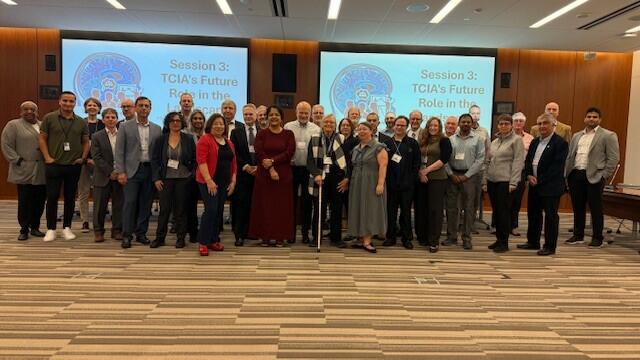
Group Picture from TCIA Strategy Workshop September 2025
The Cancer Imaging Archive is a public repository of anonymized and deidentified cancer imaging data (radiology and histology). It contains 287 TCIA-published datasets from several sources including:
- NCI clinical trials and clinical care collections (sometimes annotated to improve accessibility)
- Phantom studies
- Mouse models and a canine glioblastoma multiforme dataset
In 2025, CIP leadership convened a TCIA Strategy Workshop that discussed how TCIA should position itself for the future to meet the evolving needs of the cancer research community. Participants reaffirmed TCIA’s pivotal role in advancing cancer imaging research and open data sharing, plus the importance of avoiding duplication. They also discussed leveraging the growing ecosystem of external tools, repositories, and standards within TCIA’s pipeline.
The participants identified the following new priorities that TCIA needs to evolve and continue its support of cancer research:
- Accelerate data submission by expanding curation capacity and modernizing deidentification workflows
- Engage grantees to help meet NIH data sharing requirements
- Strengthen AI utility by including more “normal” or “control” subsets
- Harness advances in AI in areas including quality control, preprocessing, and model embeddings
- Advance pathology support by expanding plans beyond H&E with stronger metadata systems
- Emphasize deeper integration with the broader data sharing ecosystem through coordinating with other repositories and exploring tool testing, federation, and interoperability
TCIA provides extensive data deidentification and curation services to safeguard complex sharing of human subjects' data while maintaining its scientific utility. To date, TCIA’s hosted data have supported more than 3,400 publications.
DCTD funds TCIA, the Cancer Imaging Program provides scientific oversight, and the Frederick National Laboratory for Cancer Research contractually manages its program activities.