
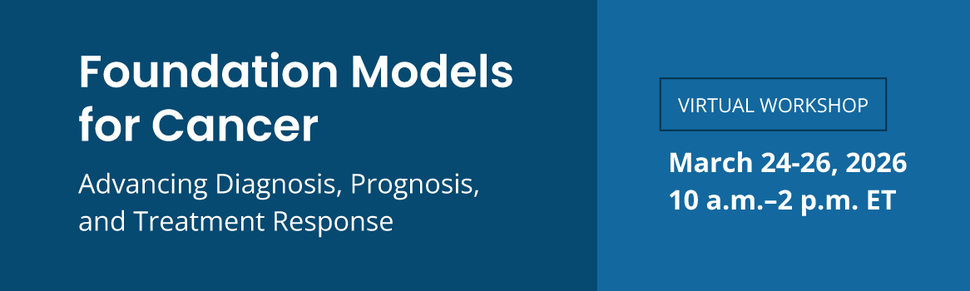
Foundation Models for Cancer: Advancing Diagnosis, Prognosis, and Treatment Response
March 24 – March 26, 2026
Workshop Overview
Hosted by NCI’s Division of Cancer Treatment and Diagnosis (DCTD) on March 24–26, 2026, this workshop focused on the emerging role of foundation models in cancer research and clinical care, particularly their ability to integrate multimodal data and support clinical decision-making.
Workshop Objectives
- Understand how foundation models can integrate multimodal cancer data (pathology, radiology, omics, electronic health records)
- Explore applications in diagnosis, prognosis, treatment response, and clinical trial design
- Identify challenges related to validation, reproducibility, interpretability, and clinical deployment
- Discuss strategies for translating AI models into real-world oncology practice
Workshop Highlights
- Foundation models present several key opportunities to advance cancer research and clinical care
- Multimodal Integration: Enable unified analysis of pathology, imaging, genomic, and clinical data
- Prediction and Simulation: Support both outcome prediction and emerging simulation of patient trajectories and treatment response
- Clinical Decision Support: Enhance workflows through applications such as trial matching, diagnostic assistance, and report generation
- Drug Development: Accelerate biomarker discovery, patient stratification, and clinical trial design
- Diagnostic Advances: Improve accuracy and consistency in computational pathology and imaging
- Data Collaboration: Federated learning enables multi-institutional model development while preserving data privacy.
- Implementation Needs: Successful adoption requires robust validation, interpretability, and integration into clinical workflow
Workshop Recordings
The player starts with Day 1, part 1; subsequent videos can be selected using the thumbnails below the main display.
View the workshop recording guide, or watch the videos on vbrick starting with Day 1, part 1 (subsequent videos are linked in the description).
Workshop Committee (in alphabetical order)
Michael Espey, Ph.D., M.T.
Sean Hanlon, Ph.D.
Subhashini Jagu, Ph.D.
Hala Makhlouf, M.D., Ph.D.
Miguel Ossandon, Ph.D.
Asif Rizwan, Ph.D.
Mugdha Samant, Ph.D.
Shannon Silkensen, Ph.D.
Brian Sorg, Ph.D., M.B.A.
Umit Topaloglu, Ph.D.
Dana Wolff-Hughes, Ph.D.